A public statement from Jena Kay, combined with a previously reported crash in a county-owned vehicle, is raising new questions about accountability inside the Mobile County Sheriff’s Office.
A Mobile County sheriff’s deputy already tied to a public internal investigation over a late-night crash is now facing a new wave of scrutiny after his ex-wife accused him of years of emotional, physical and sexual abuse.
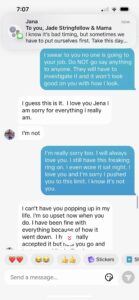
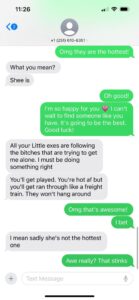
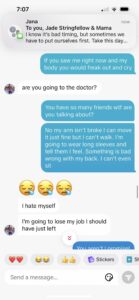
In a detailed public statement, Jena Kay said she spent years isolated, afraid, and “walking on eggshells” during the marriage. She wrote that she quit a job she had held for seven years in 2020 because she was made to feel she should not work around other men. She also described being told, during one of the darkest periods of her life, that if she ever wanted to attempt suicide again, he would “load the gun” for her.
Kay said she stayed quiet for years, covered for him when police were called during a violent episode on her 30th birthday, and was repeatedly made to believe she was the problem. “I am not crazy,” she wrote. “I am someone who survived years of abuse, manipulation, and trauma.”
Those are serious allegations, and at this stage they remain allegations, not court findings. But they do not emerge in a vacuum.
On April 3, 2025, FOX10 reported that Sheriff Paul Burch said Deputy James Gazzier had been placed on desk duty and was under internal investigation after a March 23, 2025 crash. According to the station, Gazzier rear-ended a woman’s vehicle in a county-owned unmarked truck after midnight while following her to another bar. FOX10 reported that both drivers had been drinking before the crash, both passed field sobriety tests, and no criminal charges were filed.
Even without criminal charges, the facts reported by FOX10 were troubling on their own. A deputy was allegedly using a county vehicle after drinking and wound up in a crash serious enough to trigger an internal review. That is not a minor lapse in judgment. It is the kind of conduct that should force a hard public look at supervision, discipline and standards inside a law enforcement agency.
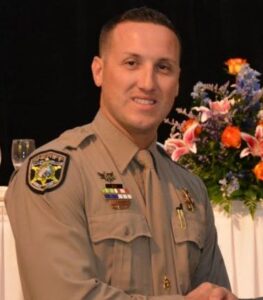
The questions become even sharper because Gazzier was not an unknown deputy buried deep in the ranks. On the sheriff’s office’s own 2024 honors page, he was listed as “Sergeant James P. Gazzier” among SWAT personnel recognized for meritorious service. That contrast is exactly why this matters. Public trust collapses when an officer celebrated inside the department later becomes the subject of abuse allegations and an internal crash investigation, yet the public is left with more silence than answers.
If even part of Kay’s account is true, this is not merely a private matter. It is a public accountability issue. Law enforcement asks victims to trust the system on their worst day. That trust is shredded when serious allegations involving one of its own are met with opacity instead of transparency.
Mobile County deserves clear answers: what the sheriff’s office knew, whether complaints were ever raised, how the internal investigation ended, and what consequences followed. A badge does not place anyone above scrutiny. And “honor, integrity and service” cannot be a slogan that stops at the department door.
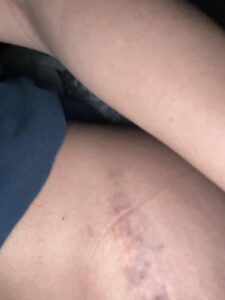
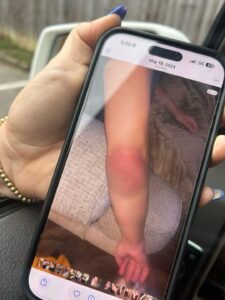
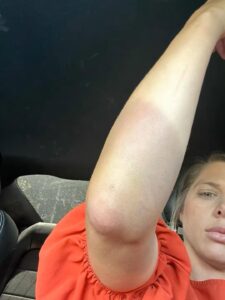
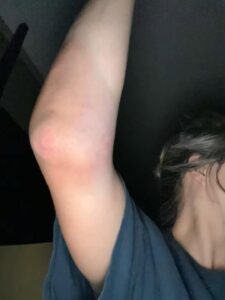
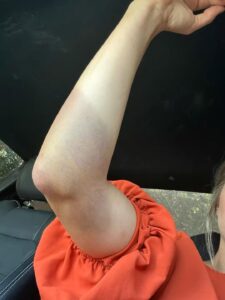
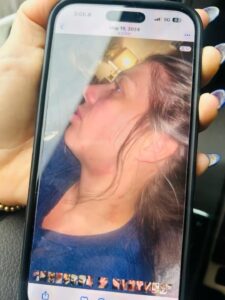
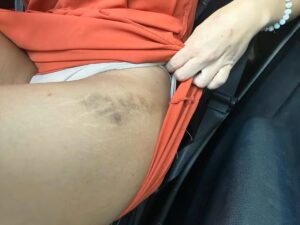
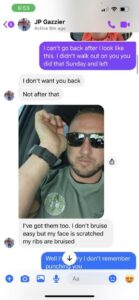
Photos provided by Kay show proof of the abuse: